

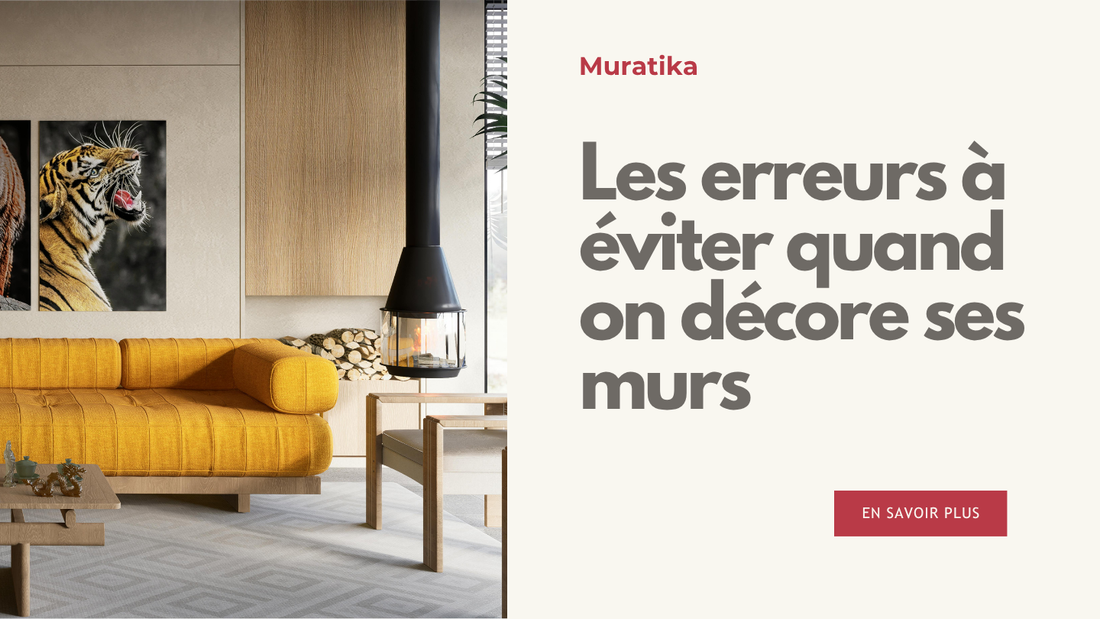
Wall decor is often that little detail that makes all the difference… or completely throws a room off balance. Because between a blank wall, an overloaded wall, or a poorly placed picture, mistakes happen quickly, even with the best intentions.
Do you want to enhance your interior, but you don't always know where to start?
In this article, we help you avoid the most common mistakes when decorating your walls, with simple and elegant solutions for a harmonious, inspiring result that reflects your style.
Summary :
- Fill all the walls at all costs
-
Ignoring proportions
- Mixing styles without coherence
-
Forget the color of the wall
- Not daring to express one's personality
- Conclusion
1. Fill all the walls at all costs
An empty wall can sometimes seem sad... Yes, and an overloaded wall feels suffocating. So, what to do? The key is to find the a perfect balance between emptiness and fullness, between breathing and expression.
Not every wall needs to be dressed up: some spaces simply need visual silence to let the room breathe.

Finding balance? It's like knowing how to dance on a tightrope.
💡Muratika Solution:
Create zones of calm and intensity.
A composition of wall decorations above a sofa, a soft drape on one wall, and leave the rest bare so that your gaze can wander freely.
It is this visual rhythm, between presence and lightness, that gives character to your interior.
2. Ignoring proportions
This is probably the most common mistake: a small frame lost on a large wall, or on the contrary, a huge work that overwhelms a space.
💡 Muratika Solution:
- Your painting or decoration should occupy 50 to 75% of the width of the piece of furniture placed underneath.
- Place your visual center 1.50m from the ground, at eye level.
(These are guidelines, not rules: adapt them according to your own feelings.)
3. Mixing styles without coherence
An abstract frame, a vintage poster, a baroque mirror… and your wall no longer really knows what it is. Diversity is beautiful, but it needs a common thread: colour, shape, material, or a shared intention .
It is this invisible thread that connects everything, that creates a story rather than a patchwork.
Too many strong elements can cancel each other out: none captures the attention, and the eye no longer knows where to rest. Conversely, a wall conceived as a harmonious composition , where each piece interacts with the others, conveys an impression of control.
💡 Muratika Solution:
Create a visual link between your elements:
- a common palette (e.g., warm or neutral tones),
- matching frames,
- or a shared emotional theme (travel, nature, gentleness…).
You can mix styles, yes, but not randomly.
4. Forget about the wall color
A magnificent work can appear bland if the background does not enhance it.
Too much decoration either "merges" with the wall color or creates too harsh a contrast.
AD France magazine highlights the importance of color in the visual structure of an interior.
We see it primarily as a dialogue: that between the wall and the artwork.
Because a well-chosen color is the invisible frame that highlights the decoration without ever stealing it.
💡 Muratika Solution:
Always test your combinations before finalizing your decoration:
- on a light wall → choose contrasting works (black, earth, gold).
- on a dark wall → focus on light (beige, off-white, warm gold).
And if you like to change often, stick to a neutral and soothing palette: it adapts to all seasons.
5. Not daring to express one's personality
Perfection doesn't exist...everyone knows that and it's okay.
Your home doesn't need to be immaculate: it simply needs to reflect you.
You can express your personality without complicating your life. The idea is not to build a “perfectly coherent” wall , but to find a gentle and natural common thread between your rooms: a color that repeats, a material that comes back, a shared emotion.
💡 Muratika Solution:
Trust yourself!
Place your frames on the floor, play with the compositions, see what pleases your eye . When a wall seems balanced and calming: that's when it's a success!
Consistency doesn't need to be calculated, just felt.
Conclusion
Decorating your walls isn't about following strict rules ; it's about finding the balance between structure and emotion. Avoid technical mistakes , but above all: let your instincts guide you.
At Muratika , we believe that a successful wall is a living wall, where each piece tells a story: yours, for example. Discover our wall inspirations to create a space that reflects your style and energy.