

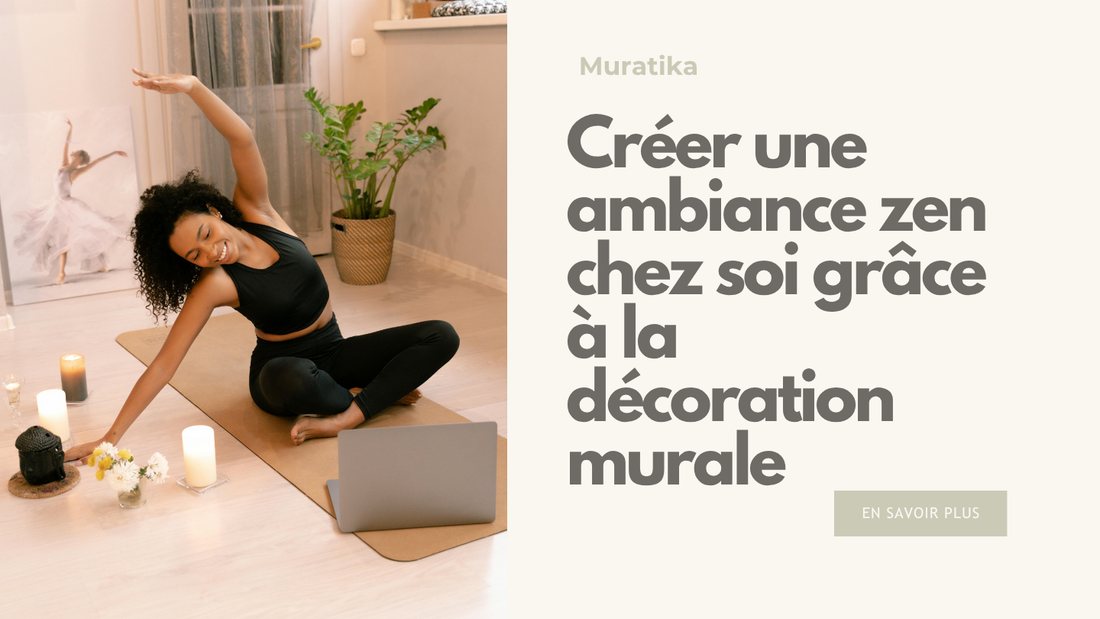
The world moves fast... Too fast sometimes. And our interiors often reflect this pace: cluttered, noisy, saturated.
So why not transform your interior into a space of calm and balance?
Decor can be much more than just an aesthetic asset. In this article, we invite you to discover how to create a zen wall decor using simple choices: materials, colors, shapes, and placement.
Summary :
- Choose the softness of natural colors
- Opt for soothing materials and organic shapes
- Adopting emotional minimalism
- Create the light of calm
- Add a touch of contemplative art
- Conclusion
1. Choose the softness of natural colors
Imagine your walls as the canvas for your well-being . For a zen atmosphere, avoid bright or saturated colors: they overstimulate the mind. Instead, opt for soft , mineral tones : light ivory, cream, cement gray, light gray, or beige.

As in the Japanese philosophy of Ma,
Beauty is born from emptiness, from the space left between things.
Psst...Any little advice?
Pair your light-colored wall with natural wall decor (linen, light wood, canvas, openwork metal). These materials capture the light and create an atmosphere that is both light and inviting.
2. Favor soothing materials and organic shapes
Our emotions are not born solely from colors : they also reside in textures and shapes.
According to Zargé Déco Design , materials possess an “emotional language”: raw wood soothes, cold metal stimulates, woven textiles envelop. And we wholeheartedly agree. Materials influence our mood as much as light.
For a zen atmosphere , opt for raw materials that are soft to the touch:
- Natural wood for its warmth.
- Rattan, for its lightness,
- Linen, for its soft, matte finish.
- Ceramics, for their stability.
- or Japanese paper ( washi ) for its poetic transparency.
Psst… any advice?
A woven wall hanging or textured artwork softens the room and subtly absorbs sound: perfect for a quiet living room or bedroom.
But serenity does not only come from materials: it also comes from forms.
In a zen decor , rigid lines and sharp angles are forgotten.
The natural curves are reminiscent of a leaf, a wave, a polished stone… and their mere presence soothes the eye.
Because you never tire of advice...
Choose organic mirrors, abstract paintings with soft outlines or motifs inspired by nature: branches, clouds, mountains.
These elements capture the light, promote relaxation and transform your wall into an interior landscape.
3. Adopt emotional minimalism
Zen doesn't mean empty. It means essential . Every room counts, every wall breathes.
How do we apply it to wall decoration?
We limit ourselves to one or two striking wall pieces in each room. A large-format painting in soothing tones, or a tapestry with a clean design, is often enough to create serenity. What matters is the energy the whole space exudes, not the quantity of objects. In a Zen interior, each wall becomes a breath of fresh air .
4. Create the light of calm
Light is the best ally of zen. A wall decoration well highlighted by soft light becomes a true emotional anchor.
Psst...Any little advice?
Install a diffused lamp, an adjustable spotlight, or a string of lights to enhance your walls. Avoid cool lights and opt for warm or golden tones, which make the room feel more vibrant and inviting.
5. Add a touch of contemplative art
Zen paintings are not just decorative — they inspire mindfulness.
An abstract work, a minimalist landscape or a composition inspired by Wabi-Sabi naturally invites us to slow down.

Psst...Any little advice?
You can install a meditative wall illustration (like an Enso circle, a lotus flower, or a misty landscape). And leave empty space around it: it's the visual silence that makes it powerful.
Conclusion
Creating a zen atmosphere at home isn't about following a style, it's about rediscovering your inner rhythm . It's about choosing less, but better. It's about preferring serenity to excess, authenticity to trends.